The Piano, an Instrument That Crosses Every Border
There are instruments associated with particular genres. The banjo belongs to bluegrass. The sitar to Indian classical music. The theremin to science fiction film scores. The piano belongs to everything.
It sits at the centre of Western classical music, jazz, blues, gospel, pop, rock, soul, R&B and electronic music in equal measure. It is the instrument composers use to sketch ideas regardless of what ensemble will eventually perform them. It is the instrument most music students encounter first. And it is the one that, once understood even at a basic level, makes every other area of music more accessible.
That crossover is not accidental. It is built into the instrument's design.
A Visual Map of Music Theory
The piano keyboard is the clearest physical representation of the musical scale ever built. Notes run from left to right in a straight, unambiguous line. Low frequencies on the left. High frequencies on the right. The pattern of white and black keys repeats every octave, giving you a visual and physical landmark system that other instruments simply do not offer in the same way.
On a guitar, the same note exists in multiple places across the neck. On a trumpet, the relationship between valve combinations and pitch requires significant mental work to internalise. On a piano, middle C is always middle C. An octave up is always twelve keys to the right. A major chord is always the same finger pattern regardless of which key you are playing in.
This is why music teachers, conservatoires and production schools around the world use the piano as the entry point to music education. It does not just teach you to play. It teaches you to hear, understand and think in music.
Elton John and the Piano as a Rock Instrument
Before the 1970s the piano in popular music was largely a supporting instrument. It sat in the backing band. It contributed chords and fills. Elton John changed that. His records from the early 1970s onwards placed the piano at the front of the arrangement, playing riffs and hooks with the same authority a lead guitarist would bring. Songs like Crocodile Rock, Your Song, Tiny Dancer and Saturday Night's Alright for Fighting treated the piano as a vehicle for energy and attitude, not just harmonic accompaniment.
The Steinway concert grand he played on stage became part of his visual identity as much as the outfits. The Steinway has a particular character, particularly in the upper register, that records with a clarity and presence few other instruments match. Yamaha grand pianos brought similar quality to a wider market, their CFX concert grand becoming a fixture in competition and recording environments through the latter half of the twentieth century.
Both brands represent the upper end of what a piano can be acoustically. But both also lent their names and credibility to digital reproductions as the keyboard market grew. Yamaha in particular bridged the gap aggressively, building digital pianos and workstation keyboards that carried the same engineering rigour as their acoustic instruments.
House Music and the Piano Chord That Defined a Generation
In the late 1980s the piano arrived in electronic music through a side door. House producers in Chicago began sampling piano chords and looping them over drum machine patterns. The effect was immediate and distinctive: the warmth and harmonic richness of a real piano laid over a mechanically precise electronic rhythm.
By the early 1990s in the UK, the piano riff was as central to house music as the synthesiser bassline. Tracks like The Source featuring Candi Staton's You Got the Love, the piano lines in early Frankie Knuckles productions and the stabs running through countless club records of that period all shared the same instrument at their core. The piano made house music feel emotional in a way that pure synthesis rarely achieved.
That tradition continues in dance music today. The piano chord sits in virtually every sub-genre of house, from deep house to progressive, from garage to melodic techno. Electronic producers who understand the piano have a harmonic vocabulary that producers who work only in MIDI patterns often lack.
Ferris Bueller's Secret Weapon
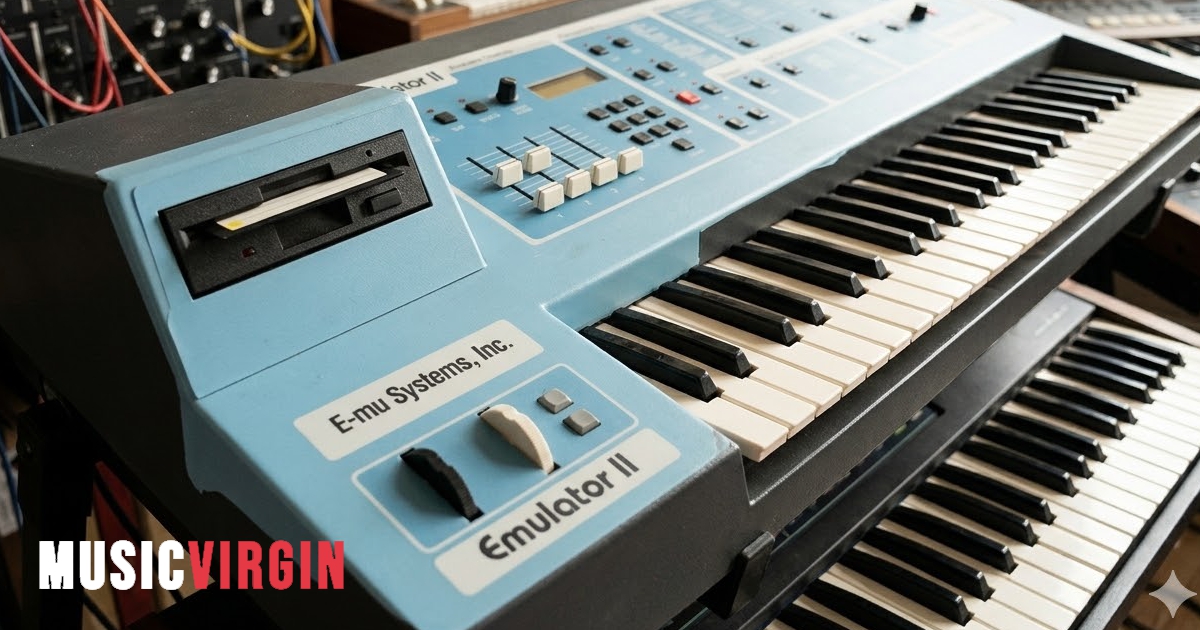
Not every use of a keyboard in popular culture has been strictly musical. In the 1986 film Ferris Bueller's Day Off, the young truant uses a keyboard to generate convincing coughs and illness sounds to deceive his parents into letting him take the day off school. The instrument in question is an E-MU Emulator II, one of the first commercially successful digital sampling keyboards. It could record any real-world sound and play it back at different pitches across the keyboard. In Ferris's hands it became a medical special effects unit.
The E-MU Emulator II was, in its day, a serious professional tool used by artists including Peter Gabriel, Herbie Hancock and Stevie Wonder for exactly the kind of realistic sound recreation you hear in the film. That a teenager used one to fake a sickie is perhaps the most entertaining footnote in the instrument's history.
Music Virgin's free online piano includes a nod to that moment. Alongside the standard piano voices you will find a selection of sounds that take a little inspiration from the Emulator's party tricks, for anyone who fancies a slice of 1980s nostalgia with their scales practice.
Where the Piano Sits Now
The acoustic grand piano remains the benchmark against which every other keyboard instrument is measured. But the category has expanded far beyond it. Digital pianos, stage pianos, synthesiser workstations, MIDI controllers and software instruments have made piano-style keyboard playing accessible at every price point and in every production context.
Learning to play, even at a basic level, opens doors that stay closed without it. Chords, melody, harmony, rhythm and arrangement all become more intuitive once your hands have spent time on a keyboard. For anyone starting out in music, whether the goal is performance, production or simply personal pleasure, the piano is the most logical place to begin.
It was true when Beethoven composed on a fortepiano in the early 1800s. It was true when Elton John played Wembley Stadium in the 1970s. It is true now, on a laptop, in a browser, with no grand piano in sight and no prior experience required. We at Music Virgin are very happy to be able to make such an instrument easily accessible and free to use for anyone! Though its really best used on either a large tablet, touch screen or desktop rather than a smaller mobile device for obvious reasons!