A Device With a 200-Year Pedigree
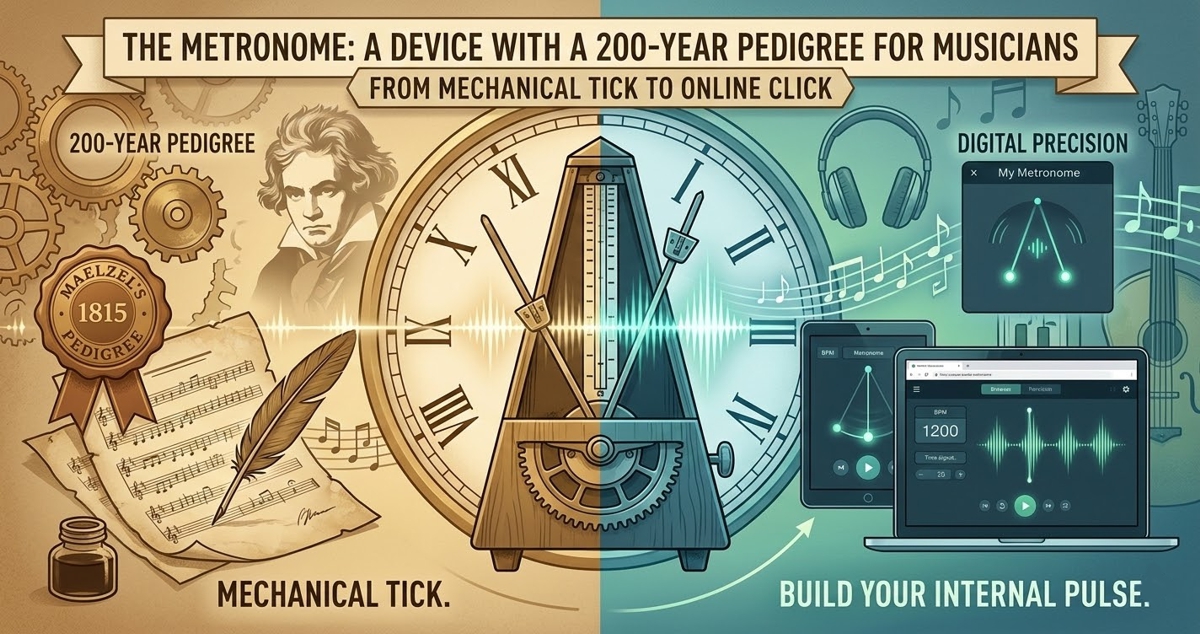
The metronome has been a fixture in music practice rooms for just over two centuries. Johann Nepomuk Maelzel patented his mechanical version in 1815, though the core mechanism was created by Dutch inventor Dietrich Nikolaus Winkel a few years before that. Maelzel's contribution was largely commercial — he refined the design, branded it and sold it to a market that was ready for it.
Beethoven was an early adopter. He began adding metronome markings to his scores in the 1810s, giving performers a precise tempo reference rather than the loosely interpreted Italian terms like Allegro or Andante that had served composers up to that point. Not everyone agreed with his markings — some conductors thought several were too fast to be practical — but the principle of attaching a number to a tempo had taken hold and never let go.
The device itself changed very little for over 150 years. The familiar pyramid-shaped mechanical metronome, with its swinging pendulum and satisfying tick, remained the standard tool in teaching studios and practice rooms through most of the twentieth century. It was reliable, portable and needed no power source. It also had real limitations.
What a Metronome Actually Does for a Musician
Timing is one of the hardest skills to develop in music and one of the most important. A technically brilliant player with poor rhythm will always sound uncertain. A modest player with solid time feels good to listen to and, crucially, easy to play with.
Practising against a metronome builds what musicians call an internal pulse — an unconscious sense of where the beat falls that does not waver when a passage gets technically demanding. Without this, tempo tends to rush during difficult sections and drag during slow or emotional ones. The metronome exposes those variations immediately and gives you something fixed to measure yourself against.
The standard approach is to set the tempo lower than you think you need, play a passage cleanly at that speed, then nudge the BPM upward incrementally. It is methodical, sometimes slow and consistently effective. There is no shortcut that produces the same result.
Ensemble musicians use it differently. Drummers and rhythm section players often practise with a click to stay tight even when the energy of a live performance pushes the tempo. Session musicians record to a click track as a matter of course. A performance that drifts even slightly becomes difficult to edit cleanly in post-production.
The Move to Digital
Electronic metronomes arrived in the 1980s and offered something mechanical devices could not: precision to a single BPM, time signature flexibility, accent patterns on beats two and three, and a visual pulse alongside the audio click. For musicians who practise in quiet environments — or who simply cannot hear the tick over an acoustic instrument at full volume — the visual element made a genuine practical difference.
Digital metronomes also removed the one thing that made the mechanical version occasionally frustrating: the need to re-set the pendulum weight every time you changed tempo. On a digital tool, switching from 72 to 120 BPM takes a single button press.
Why a Free Online Metronome Makes Sense
Music Virgin's free online metronome carries all the advantages of a digital tool without needing a download or a dedicated hardware device. It runs in the browser, responds immediately to tempo changes and includes a visual pendulum alongside the click — useful when you are across the room from your screen or playing at a volume where you need a visual cue to keep up.
For students, it removes a barrier. A decent physical metronome costs money. A browser tab does not. The result is the same: a steady pulse to practise against and, over time, the internal clock that separates a player who sounds confident from one who does not.
Two hundred years on, the function of the metronome has not changed. Only the packaging has.