What Is BPM?
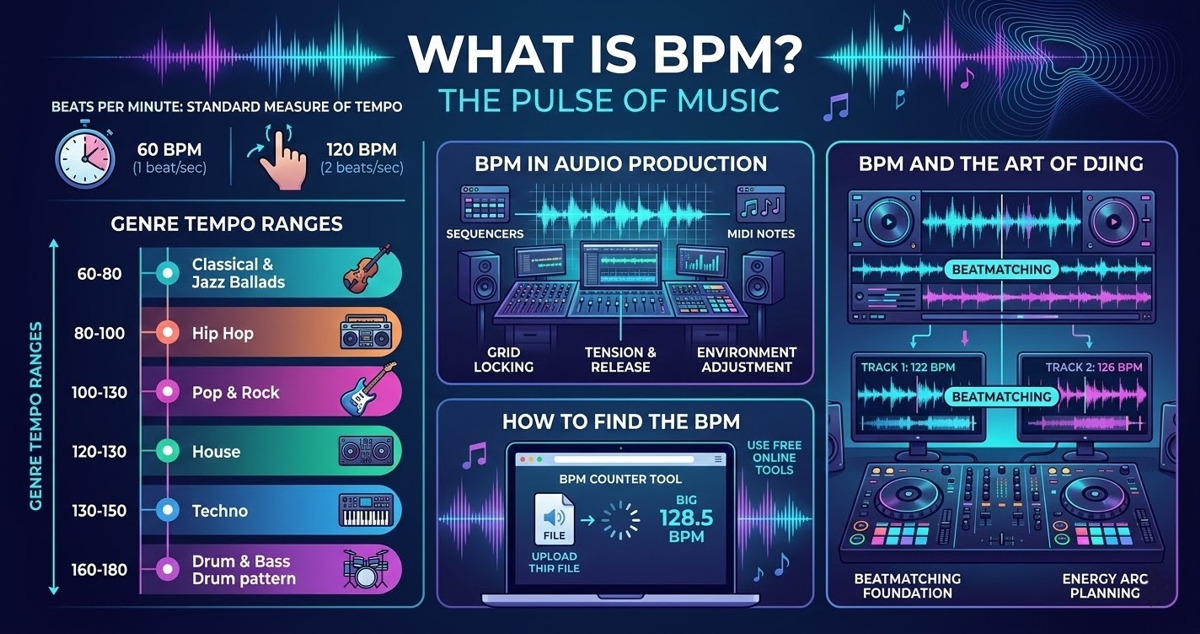
BPM stands for beats per minute. It is the standard way to measure the tempo of a piece of music. Count how many beats fall in one minute and you have the BPM. A track at 60 BPM has one beat per second. A track at 120 BPM has two.
Tempo is one of the most powerful elements in music. It shapes energy, emotion and movement before a single note is consciously processed by the listener. Get it right and everything flows. Get it wrong and even a well-written track can feel off.
How BPM Defines a Genre
Every major genre of music has a tempo range that defines its feel. These ranges are not rigid rules, but they are consistent enough that tempo alone can tell you a great deal about what you are listening to.
Classical music and jazz ballads often sit between 60 and 80 BPM. Hip hop typically runs from 80 to 100 BPM, with some sub-genres pushing closer to 140. Reggae and dub land around 60 to 90 BPM, giving them that unhurried, weightless feel.
Pop and rock tend to occupy 100 to 130 BPM, the range where music feels purposeful without feeling frantic. House music is famously anchored around 120 to 130 BPM. Techno pushes that to 130 to 150. Drum and bass operates at 160 to 180 BPM, where the kick and snare move so fast the brain starts to process them as texture rather than individual beats.
Understanding these ranges helps you place a track in its genre at a glance. It also explains why a song can feel out of place on a playlist even when the key and style match. The tempo was not right for the context.
BPM in Audio Production
In the studio, BPM is one of the first decisions a producer makes. Setting the project tempo before recording locks everything to a grid. Drums, loops, MIDI sequences and synth arpeggios all snap to that tempo. Change the BPM later and the relationship between every element shifts.
Producers also use tempo to control tension. A build that gradually increases BPM by just two or three beats creates a sense of forward momentum the listener may not consciously notice but will absolutely feel. Drop it back suddenly and the release feels enormous.
Tempo also dictates how a track translates to a live or club environment. A track that sounds powerful at home may feel sluggish in a room where the acoustics add reverb and the sound pressure is higher. Experienced producers adjust BPM with the intended listening environment in mind.
BPM and the Art of DJing
For DJs, BPM is the foundation of the craft. Beatmatching means aligning the tempos of two tracks so their beats land at the same moment. When done well the transition between tracks is seamless. When done badly, the rhythm clashes and the dance floor notices immediately.
Modern DJ software shows BPM automatically. But understanding the numbers matters beyond the technical task of matching them. A DJ who builds a set from 122 BPM to 128 BPM over an hour creates a slow, almost imperceptible energy climb. One who jumps from 128 to 140 in a single mix creates a gear shift that can either electrify a crowd or lose them entirely.
Knowing your BPMs lets you plan that arc deliberately rather than hoping it lands.
How to Find the BPM of a Track
If you have an audio file and need its tempo, the quickest method is to use a dedicated tool. Music Virgin's free BPM counter analyses your file and returns the tempo in seconds alongside a frequency breakdown and key audio stats. There is nothing to install and no account required.
It is useful when you are learning a track by ear, preparing a DJ set, or checking whether a sample will sit comfortably in a project at your chosen tempo.
BPM is not a technical detail for producers and DJs alone. It is the pulse of every piece of music ever made. Understanding it changes how you listen, how you create and how you connect tracks together.